

Latest news
For the garbage management plan required under Regulation 10.2, Annex V of the MARPOL Convention, we now offer a template containing the minimum required information.
Here you will find a template for a Garbage Management Plan (under “MARPOL Annex V”).
The EU’s NIS 2 Directive strengthens cyber security for shipping companies
With the new NIS 2 Directive on cybersecurity, the EU is expanding the binding legal framework, which is also relevant for maritime shipping companies. The new regulation replaces the previous NIS-1 Directive and leads to greater consistency, harmonization, and resilience in addressing cyber risks. In Germany, the NIS-2 Directive is implemented through the amended BSI Act (BSIG).
The NIS 2 Directive applies to shipping companies that meet certain criteria, which we have summarized for you in a concise chart.
Information on the risk management requirements and reporting obligations, registration, and any other necessary details related to the NIS 2 Directive can be found on the website of the Federal Office for Information Security (BSI).
New NOA-, TOA- und ETOA-Guidelines
The NOA, TOA, and ETOA guidelines (Guidelines for the Training of navigational, technical and electro-technical officer's assistants in maritime navigation) have been revised and entered into force on 1 June 2026.
Further information on practical training and seagoing service can be found on this website under “Training Record Books”.
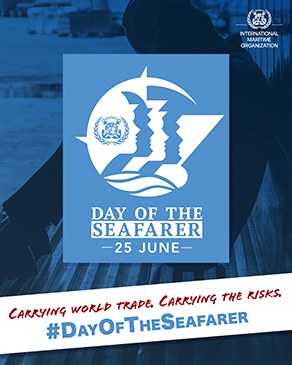
It is June 25th! We are celebrating the Day of the Seafarer with the IMO's chosen theme for this year “They carry global trade. They carry the risks”. Join in by cherishing the seafarers' work on social media - we explain how.
The German Flag is a strong partner for its seafarers. We ensure good training, fair working conditions and top tier medical support on board. Find out more about the advantages of the German Flag for seafarers and how we support the crews on German-flagged ships.
Arsenio Dominguez, Secretary-General of the IMO, addresses a message of greeting to all seafarers.
New: Checks on Board for Load Line. Click here for all of our PSC Check lists.
Protection from accidents with hazardous cargo (HNS Convention)
On 29 November 2027, the “International Convention on Liability and Compensation for Damage in Connection with the Carriage of Hazardous and Noxious Substances by Sea (HNS Convention)” will enter into force. This is possible because twelve states, representing the required total cargo volume, have acceded to the Convention – Germany was among them. This requirement was met on 29 May 2026, with an 18-month period until entry into force.
Until now, the shipping industry has already had insurance obligations for damage caused by oil (as cargo or in bulk), wreck removal, carriage of passengers, and maritime claims. Now, with the HNS Convention, this liability and compensation system is being expanded to include an additional insurance obligation for the carriage of dangerous substances at sea.
Under this agreement, shipowners are liable, regardless of fault, for damage caused by more than 2,000 HNS substances, such as chemicals, fertilizers, or LNG, and will be required to have the relevant insurance or other financial security. Additionally, an international fund will ensure that damages are compensated more quickly and that the burden on public budgets is alleviated.
Germany, represented by the BSH, will issue corresponding liability certificates in accordance with the HNS Convention; this applies to both ships flying the German flag and ships flying the flag of a non-contracting state.
Here You can find further information on the HNS Convention.
Transitional regulations due to Situation in Strait of Hormuz
Transitional regulations for Seafarers Regarding Certificates of Competency Due to the Situation in the Strait of Hormuz
The current security situation in the Strait of Hormuz may prevent seafarers from renewing or extending their certificates of competency and other supporting documents in a timely manner.
To ensure the operational readiness of ships and to provide unbureaucratic support to affected seafarers in this exceptional situation, pragmatic transitional regulations regarding seafarer qualifications are temporarily in effect. The following measures apply exclusively to seafarers who, due to their current assignment aboard affected ships in connection with the situation surrounding the Strait of Hormuz, are prevented from renewing their certificates in a timely manner.
What does this mean specifically for seafarers?
Extension of German certificates of competency and certificates of profiency:
German certificates of competency, certificates of profiency, and certificates of qualification issued by the German Maritime Administration or approved training providers remain valid automatically; whichever occurs first:
- for up to three months beyond the original expiration date, or
- until the end of the current voyage on the affected ships.
Extension of German Endorsements:
If other flag states or issuing authorities extend the validity of the underlying foreign certificates, this also applies accordingly to German endorsements. In such cases, the endorsements are extended; whichever occurs first:
- in accordance with the extended validity of the underlying certificate, but by no more than three months from the original expiration date, or
- until the end of the current assignment on board the affected ships.
Certificates of Medical Fitness for Seafarers:
For German certificates of medical fitness for seafarers, the statutory provisions of § 12 Abs. 6 SeeArbG continue to apply. This means:
- If the validity expires during a voyage, the certificate remains valid until the next port where an examination by a qualified physician is possible—but for no longer than an additional three months.
Who is eligible for these provisions?:
The transitional regulations apply exclusively to seafarers who are currently serving on affected vessels and who, due to the situation surrounding the Strait of Hormuz, are unable to renew their certificates in a timely manner.
A separate application to the BSH is not necessary. The extensions mentioned apply automatically under the specified conditions.
If there is any doubt in individual cases as to whether the seafarer is affected, this can be proven by an informal certificate from the ship’s command or the respective shipping company.
Currently longer processing time
Because of increased volume of applications, more complex examinations, and staffing shortages, there are currently longer processing times for the issuance of certificates of competency for seafarers. The current processing time is at least 12 weeks. We appreciate your understanding.
This applies to the issuance of German certificates of competency, but not to endorsements of foreign certificates of competency, for which we generally require a maximum of 3 business days.
You can help significantly to reduce processing time.
Please note our additional information on this under Initial Issuance and Extension of validity.
The IMO’s Maritime Safety Committee has finalized the MASS Code. It will take effect on 1 July 2026, on a non-binding basis.
With rapid advances in automation, digitalization, and connectivity, as well as the ever-expanding applications of artificial intelligence, the maritime industry is also facing a profound transformation. The development and construction of autonomous and remotely operated ships, also known as MASS (Maritime Autonomous Surface Ships) or USVs (Unmanned Surface Vessels), open up significant opportunities for the maritime industry.
To ensure legal certainty and create a reliable framework for research and industry, Germany is actively shaping national, European, and international developments. At the level of the International Maritime Organization (IMO), the BSH and the Ship Safety Division of the BG Verkehr have been actively participating in the development of the MASS Code (International Code for Autonomous Shipping).
The IMO’s Maritime Safety Committee (MSC) finalized the MASS Code at its 111th session. It will apply on a non-binding basis starting 1 July 2026, and is scheduled to become binding international law at a later date—currently projected for 2032. The period until the Code becomes binding will be accompanied by an Experience-Building Phase (EBP). The exact structure of the EBP will be the focus of the 112th MSC session in December.
At the national level, the MASS Coordination Group coordinates the (continued) development of the national legal framework for autonomous ships across government agencies. This group also collaboratively manages and supports application processes and research projects.
Contact: mass@deutsche-flagge.de
Chief engineer officer
The place of work is Hamburg (area of operation: North Sea and Baltic Sea).
Please apply by July 3, 2026.
Here you will find all further information about this job oportunity.
The Maritime Medical Handbook is the standard reference work in maritime medicine and is required on all seagoing vessels flying the German Flag. Now, the MediSee app - designed to complement the book - has been launched. The app provides access to life-saving instructions right from your smartphone - practical, understandable for laypeople, and free of charge. Plus, it can even be used offline.
Even on land, a medical emergency is an exceptional situation. On board, the challenge is many times greater: on the open sea, the nearest emergency doctor and the nearest hospital are often several days’ journey away. Consequently, the crew is on their own when it comes to caring for the sick and injured. The master is responsible, though treatment is usually carried out by the second navigational officer, who recently completed their medical training. Every five years, masters and navigational officers also attend medical refresher courses to prepare for handling medical emergencies. However, even the most comprehensive multi-day course cannot replace medical school. Masters and navigational officers remain medical laypeople.
This makes it all the more important that the best possible support is available on board. For ships flying the German Flag, this is primarily provided by the Maritime Medical Handbook and the corresponding emergency cards, the on-board pharmacy, and the option of telemedical maritime assistance service. All these components of medical care are closely aligned.
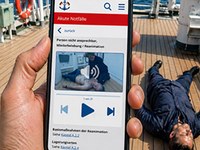
The app was developed by the authors of the Maritime Medical Handbook: Annelie Ewen (Maritime Medical Service), Dr. Philipp Langenbuch (former head of the Maritime Medical Service), and Dr. Jens Tülsner (Marine Medical Solutions). The app is published by the Federal Ministry of Transport (BMV), which also provided the funding. With this app, the German Flag is one of the first to create a digital tool for the crew on board seagoing vessels, once again demonstrating the flag’s commitment to quality and its forward-looking approach.
The MediSee app is now available for free download via the App Store (left) and the Google Play Store (right). Every crew member can easily download it to their phone and should do so whenever possible, in the interest of their colleagues and for their own sake: Because those who are prepared for an emergency can keep a clear head when it counts.


New PSC Awareness 01/2026
New FI on Conveyance of German-flagged inland waterway vessels at sea
For merchant ships flying the German flag, some new requirements for medical equipment on board have entered into force.
Aside from an equipment indexes, the new "State of medical knowledge" includes practical advice regarding storage of drugs and medical products on board. Shipowners have to apply the changes with the next annual survey of the medical equipment.
More information on the topic is given under "Maritime Medicine". A summary of the changes vis-à-vis the previous "State of medical knowledge" is provided in an information leaflet (only available in Geman).
The "Bundestag" adopted the abolishment of the seafarers' average wages from 1 January 2027. This means that in the future, social security contributions for seafarers will be calculated in the same way as for people working ashore. The German Flag becomes easier and less bureaucratic.
Up until now, social security contributions for seafarers on German-flagged sea-going vessels have not been calculated based on the actual income but according to the "average wages". These average wages are average figures for seafarers' salaries that are defined by a committee of the German Social Accident Insurance Institution for Commercial Transport, Postal Logistics and Telecommunication (BG Verkehr), on the basis of employment agreements for German maritime shipping.
On 6 November 2025 the "Bundestag" adopted amendments to the "Sozialgesetzbuch" (Code of Social Law) VI in its third reading of the act, which contains the abolishment of the average wage scheme for seafarers in Article 9 Paragraph 4. This part of the act comes into force on 1 January 2027. It accommodates the wish of the shipping companies to provide sufficient transition time to modify the payroll.
The act regulates the adjustment of the notification and contribution procedure for seafarers from average wage to actual salary. As of 2027, the same calculation and payment of social security contributions applies for seafarers as for other economic branches. The transition applies to all social security branches of the statutory social security (except for premium for sunday, holiday and night work).
The abolishment of the special arrangement for seafarers offers shipping companies the option to use the same standard accounting software as for their land-based employees if the special conditions of premiums for sunday, holiday and night work and notification procedure for seafarers is considered. The German Flag becomes easier and less bureaucratic.
According to the explanatory memorandum for the act, this simplification will not lead to any disadvantages for seafarers:
"The abolishment of the special average wage procedure for employed seafarers means that seafarers will be treated the same way as other commercial employees regarding contributions, without this leading to shifts in contributions in the form of contribution shortfalls or in the associated benefits for seafarers. The salary for seafarers already consists of basic wages, bonuses for shifts on Sunday, public holidays and during night, other benefits in kind, a flat-rate overtime allowance and the basic wage supplement entitlement. All these types of renumeration are to be included in the current or one-off remuneration pursuant to Section 14 of Book IV of the "Sozialgesetzbuch", so that the special provision for determining the average wage tables is no longer justifiable." (explanatory memorandum for Article 9 No.4 = page 76)
The act was announced in the Federal Law Gazette on 23 December 2025; the legislative procedure has therefore concluded.
The abolishment of the average wages should have already been adopted by the "Bundestag" the year prior. However, the respective legislative procedure could not be concluded due to the breakdown of the governing coalition, which led to a shortened legislative period.
Repeatedly, shipping companies reported of difficulties with ballast water management systems (BWMS) due to sediments in North Sea ports. Now the OSPAR Commission has established a new Intra North Sea Area for ballast water contingency measures.
Most ballast water management systems (BWMS) on board sea-going vessels have filtration as first stage of treatment followed by at least one more treatment stage. This way, the systems ensure no foreign organisms enter the ecosystem with the ballast water.
Practical experience has shown that some BWMS – depending on the type and installation setting on board – do not operate properly or at all in ports with high sediment load (tidal sands or silt deposition). In these cases, might only be possible to collect the ballast water via a bypass. Afterwards, the contaminated tanks and piping have to be decontaminated to comply with the mandatory ballast water standard D-2.
New Intra North Sea Area
Against this backdrop, the OSPAR Commission established an Intra North Sea Area Ballast Water Contingency and Compliance Area where the necessary decontamination procedure can be conducted in accordance with all requirements. The information "Intra North Sea Ballast Water Contingency and Compliance Area in accordance with BWM.2/Circ.62 and MEPC.387(81)" by the OSPAR Commission contains the geographic coordinates of the contingency measure area and the conditions under which a decontamination procedure is permitted there. In a few individual cases, after approval by the BSH, a ballast water exchange is also permitted.
This facilitation decided by the OSPAR Commission only applies to intra North Sea traffic and only under the conditions given in paragraphs 2 to 9 of the agreement "Intra North Sea Ballast Water Contingency and Compliance Area in accordance with BWM.2/Circ.62 and MEPC.387(81)" of the OSPAR Commission.

Practical tips
In case ballast water is intended to be taken up in a German North Sea port and problems occur or are expected to occur with the BWMS, we recommend to the ship management to contact as early as possible
- the responsible port authority and
- the Federal Maritime and Hydrographic Agency (BSH)
to coordinate the following course of action and, if appropriate, receive an approval to use the contingency measure area.
The current information Contingency measures for BWMS when encountering challenging water quality during uptake by the BSH contains tips for shipping companies and ship management which measures may be taken after agreement of the ports and the BSH when encountering problems with ballast water management systems in ports with high sediment pollution.